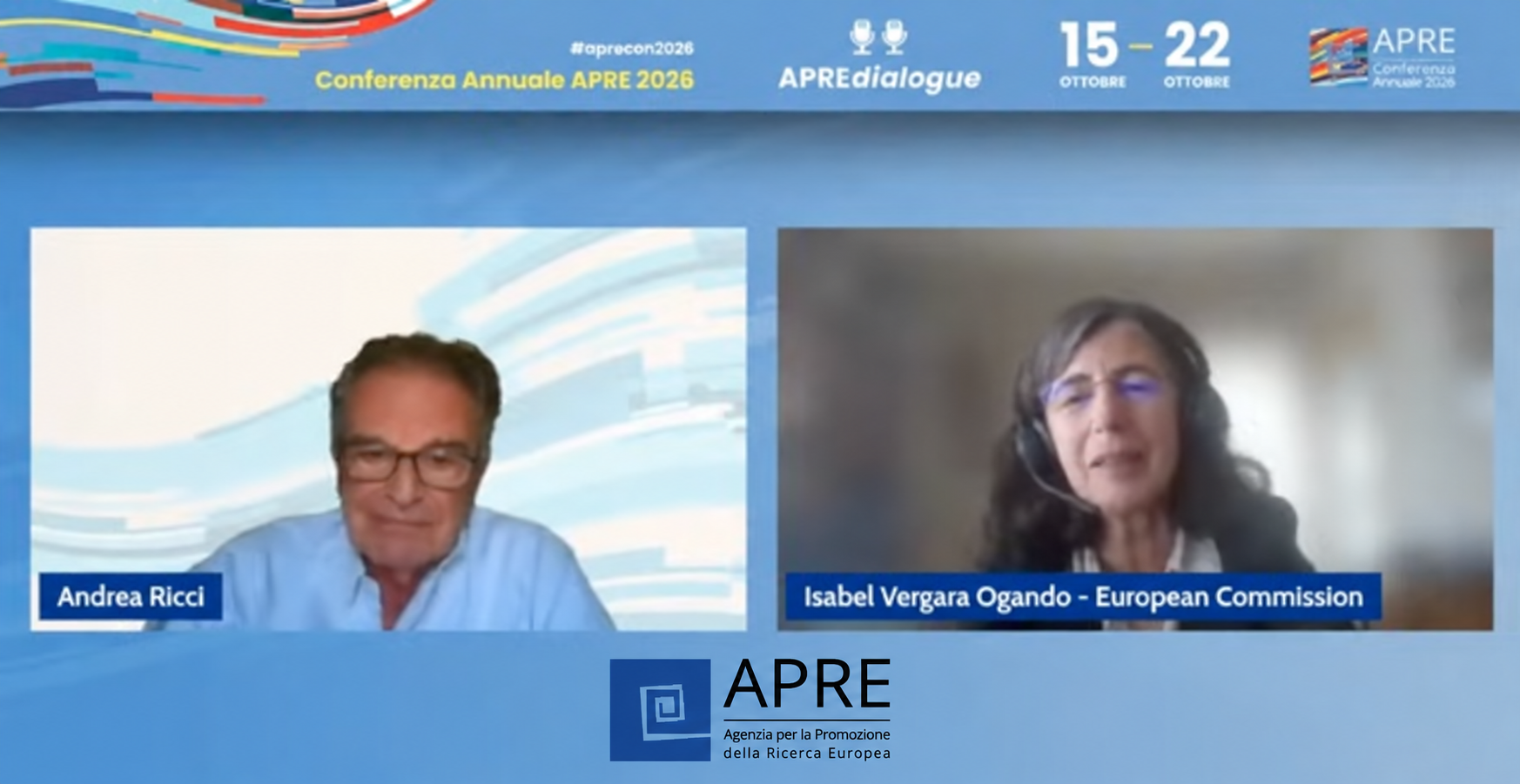
Andrea Ricci’s dialogue with Isabel Vergara Ogando at the APRE Conference
A growing number of research proposals, many of high quality, are competing for limited resources. In this context, even half a point can determine whether a proposal receives funding, making the quality of the evaluation process and applicants’ trust in it all the more important.
These challenges were the focus of the dialogue led by Andrea Ricci, Senior Advisor at ISINNOVA and Chair of APRE’s Scientific and Technical Committee, with Isabel Vergara Ogando, Deputy Head of Unit at the European Commission’s Directorate-General for Research and Innovation, during the APRE Annual Conference on 19 October 2026. The discussion explored how Horizon Europe evaluation works and the prospects for the next Framework Programme.
Clear criteria and room for expert judgement
Among the issues raised by Andrea Ricci was the relationship between detailed criteria and evaluators’ autonomy. Breaking evaluation down into numerous subcriteria can help clarify expectations, but it also risks encouraging a requirement-by-requirement approach, turning evaluation into an overly mechanistic exercise that leaves little room for evaluators’ legitimate discretion.
The quality of the selection process depends heavily on experts’ competence and the discussion between them. Remote working arrangements and consensus-building procedures affect their ability to discuss differences and reach shared judgements. The distinction between scientific judgement and factual error also matters: during the dialogue, Isabel Vergara Ogando clarified that documented factual errors should already be taken into account in evaluation review procedures, based on the content of the original proposal.
Reducing the effort required to apply
For Andrea Ricci, making the system more sustainable also means considering the time invested in preparing proposals that receive high scores but remain unfunded.
This explains the interest in two-stage applications: a genuinely short initial proposal, followed by a full application from a smaller group of applicants, could reduce the effort required at the outset. As Isabel Vergara Ogando noted, however, this approach lengthens the overall process and may be less suitable for sectors where innovation needs to be funded quickly.
AI, impact and the link with European policymaking
Artificial intelligence could provide operational support, for example by matching proposals with experts and checking evaluation reports. Throughout the discussion, human responsibility for decisions remained a firm principle.
Looking ahead to the next Framework Programme, the growing focus on European competitiveness also raises questions about how to define and assess projects’ expected impact. Ricci highlighted the importance of strengthening the connection between those who set policy priorities and those who manage funding, so that research results can feed back into European policymaking.
Improving evaluation therefore requires action at several levels, accompanied by timely guidance on any new procedures. This is essential to allow researchers and organisations to prepare, make informed decisions about investing in applications and maintain trust in the system.
Watch the dialogue between Andrea Ricci and Isabel Vergara Ogando at the APRE Conference.